Showing posts with label currently reading. Show all posts

Thursday, December 30, 2010

Through the Pages (2) - Snow Flower & the Secret Fan

"Through the Pages" Thursday is something I hope to do on a weekly basis.  Its purpose is to go beyond reading a book just to check it off a list & build up your number of reads. There is so much to learn from books - background behind its creation, history involved within the story itself (whether true history or mythical), the thoughts & impressions a certain passage may leave us with if we take the time to ponder instead of rush through. The subject matter for "Through the Pages" can be expansive if you just stop to think & let your creativity flow.

(Anyone is welcome to join me with their own current read's "Through the Pages" - just leave a comment w/ a link to the specific post on your blog.) 

I am currently reading Snow Flower and the Secret Fan, by Lisa See, a book I've been meaning to read for a few years now. I considered posting about the foot binding traditions, but was so disturbed by it, I didn't think I could stomach looking at the pictures & describing how it's done (shudder). Instead, I decided to look into nu shu, or women's writing.


Women in China were not allowed to attend school or receive an education until the early 20th century. Because of this, many were illiterate. Although no one seems to know the origins of nu shu, it is said that a young girl from Southern China created it after being chosen as the emperor's concubine. It was her way of communicating with her mother & sisters back home. Nu shu is a phonetic written language used to write stories, poetry, & autobiographies. It was also a way to write letters & communicate between "sworn sisters" (or friends) & mothers. Unlike traditional Chinese characters which are boxy, nu shu was slanted, long & frail.

Nu shu was a secret language hidden from men & was often disguised to look like art. It was also embroidered onto everyday items & clothes.


 With the increase in literacy among women in the 20th century, nu shu began to fade away & was no longer needed. It is now considered an endangered language.

Information researched on Wikipedia & Lisa See's webpage.

Thursday, December 16, 2010

Through the Pages Thursday (1) - The Pillars of the Earth

"Through the Pages" Thursday is something I hope to do on a weekly basis.  Its purpose is to go beyond reading a book just to check it off a list & build up your number of reads. There is so much to learn from books - background behind its creation, history involved within the story itself (whether true history or mythical), the thoughts & impressions a certain passage may leave us with if we take the time to ponder instead of rush through. The subject matter for "Through the Pages" can be expansive if you just stop to think & let your creativity flow.

(Anyone is welcome to join me with their own current read's "Through the Pages" - just leave a comment w/ a link to the specific post on your blog.) 

I am currently reading The Pillars of the Earth by Ken Follett - a book I've meant to read for a few years now, but kept putting off because of its massive size! I finally added it as one of my books for a tbr (to be read) challenge this year. Of course, I put it off again & saved it for the last qualifying month of the challenge! Although the size intimidated me, & I was unsure if a book like this would hold my attention (do I really want to read about the building of a cathedral?), it pulled me right into the story from the outset & has not been a dissapointment in any way yet.

 Ken Follet wrote thriller novels before coming out with his first historical fiction, this one. When telling why he took on this project he said:

[I] read a couple of books on architecture and developed an interest in cathedrals. Before too long, it occurred to me to channel this enthusiasm into a novel. I knew it had to be a long book. It took at least thirty years to build a cathedral and most took longer because they would run out of money, or be attacked or invaded. So the story covers the entire lives of the main characters. My publishers were a little nervous about such a very unlikely subject but, paradoxically, it is my most popular book. It's also the book I'm most proud of. It recreates, quite vividly, the entire life of the village and the people who live there. You feel you know the place and the people as intimately as if you yourself were living there in the Middle Ages.


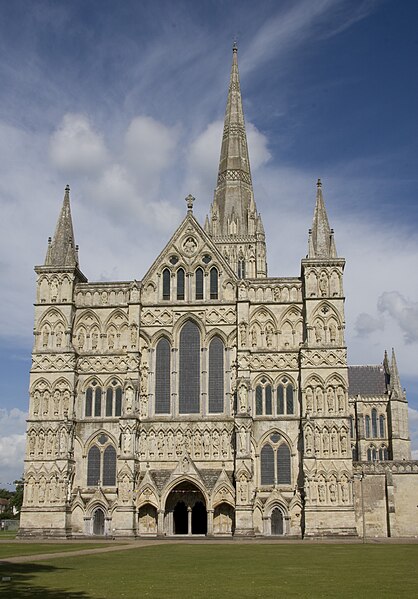
Follett fashioned the cathedral in his book after Wells & Salisbury Cathdrals in England.
Painting of the Salisbury Cathedral
Commisioned in 1825 by John Fisher, Bishop of Salisbury

The immense grandeur & size of cathedrals is meant to give glory to God & can be a reflection of the wealth of its patrons.

 
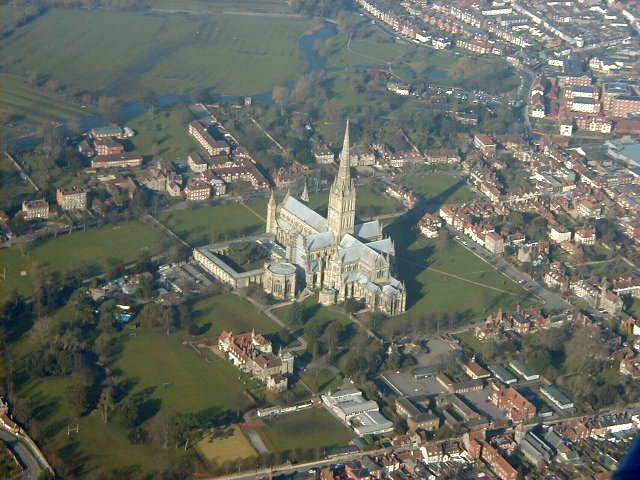
Cathedrals are traditionally built in the shape of a cross to symbolize the cross that Jesus Christ was crucified on. They also tend to be situated east to west to symbolize the Risen Christ & to allow for the sun to shine through the windows behind the altar during worship. 
aerial view of Salisbury Cathedral

The main body of the Cathedral is called the nave & is where worshipers congregate. "Nave" comes from the Latin word for ship, as to bear the congregation safely through the storms of life.
Nave of Salisbury Cathedral

The arms of the cross are called transepts & oftentimes contain many small chapels. 
Transepts in gray

I'm surprised at how much more depth researching cathedrals has added to my understanding of The Pillars of the Earth, especially since the construction of cathedrals plays such a major role. I love learning about the symbolism & seeing pictures & floorplans of the architecture - it really helps me visualize what I'm reading about. Now I just hope I can continue to make research a part of the other books I read!
Information researched on Wikipedia

Sunday, October 17, 2010

Currently Reading = The Woman in White by Wilkie Collins

Written in 1859 by William "Wilkie" Collins, this is considered one of the first mystery novels & is an early example of detective fiction, which many others modeled their own detective stories after. Collins was a good friend of Charles Dickens & received even greater success than his contemporary, being the most loved & best paid Victorian author for a time. His great success continued until his death in 1870, when Dickens' reputation rose to take Collins' place.

My first impressions of this novel are that it reads very easily (considering when it was written), & the more I read it, the harder it is to put down. I am about 1/3 of the way through & am anxious to see where everything leads.