Showing posts with label historical fiction. Show all posts

Thursday, April 21, 2011

Review - Sarah's Key, by Tatiana de Rosnay

Released: June 2007
Publisher:  St. Martin's Griffin
Audience: Adult
Genre: Historical Fiction, WWII
Source: Owned
Summary from Goodreads:

Paris, July 1942: Sarah, a ten year-old girl, is brutally arrested with her family by the French police in the Vel’ d’Hiv’ roundup, but not before she locks her younger brother in a cupboard in the family's apartment, thinking that she will be back within a few hours.
Paris, May 2002: On Vel’ d’Hiv’s 60th anniversary, journalist Julia Jarmond is asked to write an article about this black day in France's past. Through her contemporary investigation, she stumbles onto a trail of long-hidden family secrets that connect her to Sarah. Julia finds herself compelled to retrace the girl's ordeal, from that terrible term in the Vel d'Hiv', to the camps, and beyond. As she probes into Sarah's past, she begins to question her own place in France, and to reevaluate her marriage and her life.

Tatiana de Rosnay offers us a brilliantly subtle, compelling portrait of France under occupation and reveals the taboos and silence that surround this painful episode.

Review:

I avoided this book for a long time - a combination of all the hype around it & the disturbing subject matter. After looking at it on my shelf for a while, I decided I just needed to start. I had very low expectations, mostly due to the fact that so many hyped books I've read lately have fallen short. So I was surprised to find that I really loved this book! (It is my favorite read of the year so far.)

Tatiana de Rosnay wove a beautiful story of past & present, the story of a young girl's experience with the Jewish roundup in Paris, 1942, & the story of a woman journalist researching that horrific part of French history in the present.

Rosnay alternated back & forth between the two narratives for the first half of the book, allowing us to learn bits & pieces of these two lives & the mystery around Sarah, the little Jewish girl. She then focused on Julia for the second part of the book (something I had to get used to since I really loved the little girl's narrative & missed it once it was gone). While I wasn't crazy about Julia's character at first, she grew on me. She started out reserved & weak & then grew into such a strong, take-charge woman. The story of Sarah was a horribly sad one, & I found myself crying often throughout this book. Hearing about the Holocaust & from the perspective of a young French girl was different than anything I'd ever come across before, & it was heartbreaking. While reading this story & visualizing all the Jewish children with the stars sewn onto their clothes, I kept thinking about Dr. Seuss' The Sneetches. I read this book often as a child & still think about it years later. It made me think how ridiculous it was to label someone with a star to prove that they were beneath you, or, in The Sneetches, that those wearing the stars were better than the rest. I kept thinking, "We're all part of the human race. How could anyone be so prejudiced & full of hate for another person?" It is something I just can't comprehend.

This book was very touching to me, & while I won't jump to read another book by this author in the near future (again, the difficult subject matter), I do plan to read more of her work when I can.

5/5
""How was it possible that entire lives could change, could be destroyed, and that streets and buildings remained the same, she wondered." ~ Tatiana de Rosnay, Sarah's Key

Thursday, January 6, 2011

Author Interview & Giveaway - Holly Weiss' Crestmont!

Author Holly Weiss was kind enough to do an interview for her debut novel Crestmont! She has also offered up a signed copy of her book for giveaway. She has also included a Crestmont bookmark (to enter, fill out form at bottom of post). I finished reading this book around the holidays & felt a great connection to the Crestmont Inn & the richness of its history & continuing traditions. It was a fun, sweet read.

Title: Crestmont
Author: Holly Weiss ~ website, twitter
Released: April 2010
Publisher:  Star Publish
Pages: 309
Purchase: Amazon


"A dream, after all, needn't be fueled by particulars, only by desire."

So notes main character, Gracie Antes, in CRESTMONT, a historical fiction gem set in the 1920s.

Determined to take control of her life, sheltered Gracie Antes leaves her unhappy home in 1925 to pursue her dream of a singing career. On her way to the big city, she accepts a job as a housemaid at the bustling Crestmont Inn. Once there, Gracie finds a life-changing encounter with opera singer Rosa Ponselle, family she never imagined could be hers, and a man with a mysterious past. Relive the 1920s with a colorful cast of characters. Discover with Gracie that sometimes we must trade loss for happiness.

Set in Eagles Mere, Pennsylvania, the story is interwoven with details about the town, the rich history of The Crestmont Inn, and the family who passed ownership from one generation to the next.

Many attempts have been made to explain how the mountaintop lake nestled in this tiny town came to be. Crestmont gives a new twist to an old Native American legend, setting the tone of grace around which the story is built.

Let the period of the Roaring Twenties spark your interest with its unique social mores, fashion, jazz, and yes, a little bootlegging thrown in for pizzazz.

First off, how did you learn about the small town of Eagles Mere, Pennsylvania?
I want to thank you for this opportunity to do an interview on Through the Pages. I think your blog is creative, well-researched and in-depth, and I’m honored to be here.

My husband and I were looking for a place to stay overnight to break up a long drive home from visiting my family. I found The Crestmont Inn on a lark on the internet. Once in the charming mountaintop town of Eagles Mere, I was hooked. By the way, the permanent residency there is only 127 people!

Have you always wanted to write a novel? What inspired you to write Crestmont?
I’ve always enjoyed writing, but was not serious about it until 2006. I sang professionally for thirty-five years. My main means of creative expression was through song. But five years ago, I contracted Post-Polio Syndrome, a late-life extension of the polio I had as a child. The increased weakness and fatigue put an end to my singing career. God led me in the direction of writing. One voice led to another, so to speak. Writing is now my means of creative expression, but music will always be an integral part of me.

Our one-night stay at the inn inspired me to write Crestmont. The restful atmosphere of the inn, the graciousness of the innkeepers and the beauty of the surrounding area captivated me. More importantly for the book, the rich history of the inn struck me. We stayed in The Evergreen Lodge, which was converted into its current form from staff quarters built in 1926. Small staff rooms that housed two or three waitresses in the 1920s through the 1970s were cut through to create the large and luxurious suite where we stayed. Original transoms over the doors and antiques from the inn’s early years perked my interest about how these staffers lived and worked.

William Warner's ideas for the future Crestmont, as you wrote them, sound ideal - the place for the perfect getaway. How did your stay there compare to his early vision?
the original Crestmont Inn
William Warner built the Crestmont Inn in 1899 to provide respite for people pummeled by the stress of everyday life. The current owners, the Mulford’s, have carried on that tradition. Foresight and attention to the needs of guests who walk through the Crestmont Inn’s doors are their hallmarks. Each time I visited to research and write mementos from the old inn, such as a brochure from 1904, postcards from the 1920s era, old stationery, had thoughtfully been placed in my guest room. The Mulford’s own stories about “difficult and unusual guests” found their way into the novel. The scene where Margaret Woods pulls the burning tablecloth out of the fireplace actually happened in 2003, not 1927. Anything I needed along the way, they gladly gave. They gave me the image of the porch filigree which I used on the cover of “Crestmont” was from their professional photo shoot. When I had a book signing in Eagles Mere in August, the Mulford’s hosted an open house for me and even arranged for a family who was staying at the inn to play Celtic music on the porch. Creative people who produce seemingly effortless special touches draw guests back time after time.


Which character do you most relate to? Was there a character that was difficult to write/create? Did you base any of the characters on people you know?
Yes, I did. I based both Margaret Woods and Gracie on aspects of myself in different phases of my life. Today I identify most with Margaret Woods. We are both type A’s, are overworked, and struggle to balance family and our professions. Margaret has difficulty letting go of her grief after her father’s death. It was no accident that many of those scenes were written the year after my mother passed away. Writing them was very therapeutic for my grief process.

Drawing a character from one’s own life carries with it the danger of assuming self- absorption when the writer is asked to articulate the character’s origin. Without becoming overly personal, I’ll simply say that Gracie begins the novel in a somewhat broken emotional place similar to where I found myself twenty years ago. Some reviewers have called her everything from “refreshingly naïve” to “weak and timid.” I stand by her characterization. What is important to me is not where a person starts but how she stretches herself. What happens to us doesn’t count, but rather what we make of it. Long before self-help books were on the shelf, Gracie struggled to find herself — and flourished. I’d rather you read her journey than to tell you mine.

Bessie was challenging, but enjoyable to write. She says and does everything your mother warns you not to. Nine-year-old Eleanor is the first in “Crestmont” to recognize that Bessie had hurtful things in her life and that her abrasive conduct is a defense mechanism. Inventing Bessie’s “lingo” was a blast. Whenever my husband would read a section where Bessie said, “Slammin’ Jack,” he’d ask me, bewildered, where that expression came from. I would just shake my head and say “Out of Bessie’s mouth!”

Rosa Ponselle
Singing plays a big part in this novel with Gracie's character & the appearance of historical opera singer Rosa Ponselle. What is your personal history with singing, & why was it important to include it in Crestmont?Singing has been a huge part of my life for over thirty-five years—as a soloist, on the opera stage and as a teacher of singing, so I think it was inevitable that much of that spilled over into Crestmont. Gracie meets a famous opera singer, Rosa Ponselle, who is doing a concert at the Crestmont. They become close and Ponselle gives Gracie a voice lesson. I wanted my voice students to enjoy that aspect of the novel.

Although I had to give up my own singing career, including details about a singer’s life in the character of Rosa Ponselle was fun. Ponselle’s conviction that you must sing what you feel will touch others comes from my own experience. Miss Ponselle and I have something in common also. She retired from the opera stage at a fairly young age as well.

What responsibility did you feel, if any, to the Crestmont Inn & its founders by writing a story that would bring this small mountain treasure & its history to life?
It was a daunting responsibility which I took very seriously! I travelled to Eagles Mere, PA, to the current day Crestmont Inn, several times during the writing of the novel to interview the current owners, former staff and townspeople. People who were on staff at the “old” Crestmont – the one I refer to as the “big house” in the book, gave me floor plans and photographs of the real owners and many of the inn itself. When people in Eagles Mere heard I was writing a book about the Crestmont, they perked up and said things like, “My aunt loved working there.” Or “Oh, that old Crestmont was quite a place.” I wanted to be true to their memories. During one of my Crestmont signings, an elderly lady brought me photos and mementoes from when she worked there as a teenager. She was thrilled to share them with someone else who cared about the old Crestmont. I was honored she chose me.

Gracie started out as a fairly self-isolated character. What was significant about the relationships she eventually made with those around her?Gracie had to learn that it was okay to be Gracie. She found little support from her own family, so forging new relationships helped her to figure out who she was. The fact that the Woods, Dorothy, Olivia and Isaiah genuinely liked and cared for her was a huge boost to her self-esteem. She felt safe enough with them to walk down a path of self-discovery.

What was the single most important thing you wanted to relate to readers when writing this book? Grace—favoring others with unmerited kindnesses—always triumphs. I purposefully named my main character Grace (later, Gracie) because I wanted that theme to pervade the novel. I introduced the concept when I gave a different twist to a Native American legend. Instead of flooding the lake out of anger, in Crestmont, the Great Spirit filled the lake with tears of forgiveness.


You wrote a strong theme of family into Crestmont. How important is family both to you and to the story?

I wanted family to be key in the concept of the book, but not in the traditional sense. My father always said, “If you don’t have family, you don’t have anything.” I agree with him completely, but one thing I wanted to show in Crestmont that family can also be found outside of one’s biological family. The novel is dedicated to my parents, who are both gone now. It would have made them happy to know that I decided to write my grandfather, Warren Sloan, into the novel. He invented the automatic pinsetter for bowling alleys (although he sold it shortly after) and gave me the perfect way to round out PT’s earlier life with Sloan as his mentor. Neither Gracie nor PT has family to speak of, but find it at the Crestmont.

I also decided to include my husband‘s poetry in the book. He is the “Paper bag Poet” whose poems prompt Gracie’s yearning for love. He actually wrote one of the poems to me while we were courting. How could I leave that out?

Do you plan to write anything in the future?
I am busy writing reviews of newly released books now. For my next novel, I want to explore the One Voice Led to Another concept. I may retell my “polio/professional singer becomes writer story”, or I may use some amazing life transition stories shared with me by friends.

If you could travel to any time & place in history, when & where would you go? Why?
I’d love to be in a room filled with all the books I’d like to read – and actually have the time to read them! In doing that, I could travel all over the globe and history. Having my hubby next to me while we sip cappuccino and read would be the ultimate delight!

Sunday, January 2, 2011

Review - Snow Flower and the Secret Fan by Lisa See

Author: Lisa See
Released: 2005
Publisher:  Random House
Pages: 253
Rating: 4.5/5
Purchase

Summary
In nineteenth-century China, in a remote Hunan county, a girl named Lily, at the tender age of seven, is paired with a laotong, “old same,” in an emotional match that will last a lifetime. The laotong, Snow Flower, introduces herself by sending Lily a silk fan on which she’s painted a poem in nu shu, a unique language that Chinese women created in order to communicate in secret, away from the influence of men. As the years pass, Lily and Snow Flower send messages on fans, compose stories on handkerchiefs, reaching out of isolation to share their hopes, dreams, and accomplishments. Together, they endure the agony of foot-binding, and reflect upon their arranged marriages, shared loneliness, and the joys and tragedies of motherhood. The two find solace, developing a bond that keeps their spirits alive. But when a misunderstanding arises, their deep friendship suddenly threatens to tear apart.

Review:
I remember studying Ancient China back in elementary school & always being fascinated by its history. However, I don't remember much from all those years ago. So now when I think of Chinese history/culture, these images come to mind: (click on them to go to a Wiki article)


Reading Snow Flower and the Secret Fan showed me a completely new side of China through the lives of two women - laotong, or old sames. Lisa See described in detail the atrocities of war & poverty, but most importantly, the hardships that come with being born a daughter in China. She painted a very realistic & eye-opening picture (at least I was convinced) of women in 19th century China where they were considered wortheless except for their ability to bear sons. It showed an oftentimes startling view of how women were treated & what was expected of them. They were forbidden an education, which led them to using a secret written language, nu shu, to pass stories, poems & messages along to other women. See's vivid description of foot binding (a whole chapter is dedicated to it) left me with my head between my hands, concentrating on my breathing, so I literally wouldn't throw up. (I've never had a book get that sort of reaction out of me!)

See, through her deep & detailed writing was able to beautifully & heartbreakingly portray the relationships of women with those around them: their mothers who showed mother-love (tough love is how I interpreted it), fathers, siblings, husbands, sworn-sisters, matchmakers & laotong. The language used throughout the novel conveyed the poetic & symbolic Chinese tongue, which I greatly appreciated. It made me feel as though I were witnessing the true lives of those from another time & culture instead of getting a fictionalized account of China written by a tourist. It felt genuine.

I also felt a great connection to the main women in the story, Lily & Snow Flower, two friends whose friendship & laotong bond was brought about through unlikely circumstances. They were strong & devoted women in their own way, & through them, the reader was able to feel the significance of such a relationship in a male-dominated world.

4.5/5

"For my entire life I longed for love. I knew it was not right for me — as a girl and later as a woman — to want or expect it, but I did, and this unjustified desire has been at the root of every problem I have experienced in my life."
~ Lisa See, Snow Flower and the Secret Fan

Thursday, December 30, 2010

Through the Pages (2) - Snow Flower & the Secret Fan

"Through the Pages" Thursday is something I hope to do on a weekly basis.  Its purpose is to go beyond reading a book just to check it off a list & build up your number of reads. There is so much to learn from books - background behind its creation, history involved within the story itself (whether true history or mythical), the thoughts & impressions a certain passage may leave us with if we take the time to ponder instead of rush through. The subject matter for "Through the Pages" can be expansive if you just stop to think & let your creativity flow.

(Anyone is welcome to join me with their own current read's "Through the Pages" - just leave a comment w/ a link to the specific post on your blog.) 

I am currently reading Snow Flower and the Secret Fan, by Lisa See, a book I've been meaning to read for a few years now. I considered posting about the foot binding traditions, but was so disturbed by it, I didn't think I could stomach looking at the pictures & describing how it's done (shudder). Instead, I decided to look into nu shu, or women's writing.


Women in China were not allowed to attend school or receive an education until the early 20th century. Because of this, many were illiterate. Although no one seems to know the origins of nu shu, it is said that a young girl from Southern China created it after being chosen as the emperor's concubine. It was her way of communicating with her mother & sisters back home. Nu shu is a phonetic written language used to write stories, poetry, & autobiographies. It was also a way to write letters & communicate between "sworn sisters" (or friends) & mothers. Unlike traditional Chinese characters which are boxy, nu shu was slanted, long & frail.

Nu shu was a secret language hidden from men & was often disguised to look like art. It was also embroidered onto everyday items & clothes.


 With the increase in literacy among women in the 20th century, nu shu began to fade away & was no longer needed. It is now considered an endangered language.

Information researched on Wikipedia & Lisa See's webpage.

Wednesday, December 29, 2010

Review - The Pillars of the Earth by Ken Follett

Author: Ken Follett
Released: February 2002 (1st published in 1989)
Publisher:  NAL Trade
Pages: 976
Rating: 5/5
Purchase

Summary:
An enjoyable historic thriller, well told. A mystifying puzzle involving the execution of an innocent man, the erection of a magnificent cathedral, romance, rivalry, murder, arson, lust, and love. Set in 1135 England.

Tells the story of Philip, prior of Kingsbridge, a devout and resourceful monk driven to build the greatest Gothic cathedral the world has known... of Tom, the mason who becomes his architect - a man divided in his soul...of the beautiful, elusive Lady Aliena, haunted by a secret shame...and of a struggle between good and evil that will turn church against state and brother against brother.

Review:
The Pillars of the Earth follows the lives of Tom Builder & his family, Lady Aliena, Prior Philip, Jack Jackson, William Hamleigh & many others in Medeival England. You witness Civil War, heartless Earls, corrupt bishops, famine, the building of a cathedral, endurance, renewed hope, & love.

Even though I'd heard how amazing this book was, I always pushed it aside for something else, partly because I wasn't sure I cared to read about the building of a cathedral, but even more so because of its near 1,000 pages (32 discs on audio!). This book was going to be a commitment! But man, am I glad I took the time for this big boy. This book pulled me in dramatically from the very start. Follett's ability to bring the characters to life was incredible! I came to a point in the book (a couple points, really) when I felt like I'd been punched in the gut & actually mourned for the characters. At other times, I laughed out loud & rejoiced with them. It shocked me to feel so involved in their fictional lives!

This book alternated between different narrators. In some books this is frustrating b/c certain characters' stories are never as interesting as others'. I didn't find that to be the case in Pillars.  I would get so involved with one narration, & then it would switch to another's perspective. I would hate seeing some narrations end, but would quickly get caught up in the new one. There was hardly an uninteresting moment throughout the book. The story completely captivated me!

I also appreciated the research Follett did in writing this, not only about that time in history, the culture, land, laws, . . . but also the actual construction of the cathedral. I found it fascinating!

This is one of the best written books I've read, & I consider it a new favorite. I highly recommend it!

5/5

"Having faith in God did not mean sitting back and doing nothing. It meant believing you would find success if you did your best honestly and energetically."
~ Ken Follett, The Pillars of the Earth

Saturday, December 18, 2010

Review - The Gargoyle by Andrew Davidson

I love the cover - it is so gorgeous!
Author: Andrew Davidson
Release: August 2008
Publisher:  Doubleday
Pages: 480
Rating: 5/5
Purchase: Amazon

Summary:
An extraordinary debut novel of love that survives the fires of hell and transcends the boundaries of time.

The narrator of The Gargoyle is a very contemporary cynic, physically beautiful and sexually adept, who dwells in the moral vacuum that is modern life. As the book opens, he is driving along a dark road when he is distracted by what seems to be a flight of arrows. He crashes into a ravine and suffers horrible burns over much of his body. As he recovers in a burn ward, undergoing the tortures of the damned, he awaits the day when he can leave the hospital and commit carefully planned suicide—for he is now a monster in appearance as well as in soul.

A beautiful and compelling, but clearly unhinged, sculptress of gargoyles by the name of Marianne Engel appears at the foot of his bed and insists that they were once lovers in medieval Germany. In her telling, he was a badly injured mercenary and she was a nun and scribe in the famed monastery of Engelthal who nursed him back to health. As she spins their tale in Scheherazade fashion and relates equally mesmerizing stories of deathless love in Japan, Iceland, Italy, and England, he finds himself drawn back to life—and, finally, in love. He is released into Marianne's care and takes up residence in her huge stone house. But all is not well. For one thing, the pull of his past sins becomes ever more powerful as the morphine he is prescribed becomes ever more addictive. For another, Marianne receives word from God that she has only twenty-seven sculptures left to complete—and her time on earth will be finished.

Already an international literary sensation, The Gargoyle is an Inferno for our time. It will have you believing in the impossible.

Review:
When I think about Andrew Davidson's The Gargoyle, the words that come to mind are grotesque, graphic, disturbing . . . magical, beautiful, unforgettable. After hearing so many wonderful things about this book, I was really excited to read it. But I have to admit it was difficult for me to get into, & I was kind of disappointed. Don't get me wrong - I think Davidson is an INCREDIBLY talented & creative writer, & I ended up changing my tune, but I struggled at first with the slower pace & quite depressing subject matter. I was shocked by the narrator's career as a porn star & didn't care for the explicit descriptions involved, (You've been warned!) but was glad I continued reading after some encouragement from my friends.

I found the description of the accident, burns, & medical procedures horribly disturbing & had to skim through parts. At the same time, Davidson's descriptions were so real, uncensored & blunt that I found them surprisingly beautiful!

I very much enjoyed the stories within the story as they transported me to the past & to different lands: Japan, Italy, Iceland, Germany, England; relating the difficult yet beautiful accounts of human love & devotion. It was a constant battle trying to distinguish between a storyteller's wild imagination & the possible reality of a love that had truly lasted through the ages.

The haunting imagery from Dante's Inferno ran throughout the book & was definitely the highlight for me. I also loved the way the character's mindset & horrific situation had me reflecting on my own attitude & appreciation for life, my feelings of self-doubt, the worth of a soul, & the redeeming power of love.

I highly recommend this book (if you can get past some of the difficult-to-read parts). It was one of my favorite reads of the year!

5/5

"None are here by accident. Hell is a choice because salvation is available to anyone who seeks it. The damned choose their fates, by deliberately hardening their hearts."
~ The Gargoyle, Andrew Davidson

Thursday, December 16, 2010

Through the Pages Thursday (1) - The Pillars of the Earth

"Through the Pages" Thursday is something I hope to do on a weekly basis.  Its purpose is to go beyond reading a book just to check it off a list & build up your number of reads. There is so much to learn from books - background behind its creation, history involved within the story itself (whether true history or mythical), the thoughts & impressions a certain passage may leave us with if we take the time to ponder instead of rush through. The subject matter for "Through the Pages" can be expansive if you just stop to think & let your creativity flow.

(Anyone is welcome to join me with their own current read's "Through the Pages" - just leave a comment w/ a link to the specific post on your blog.) 

I am currently reading The Pillars of the Earth by Ken Follett - a book I've meant to read for a few years now, but kept putting off because of its massive size! I finally added it as one of my books for a tbr (to be read) challenge this year. Of course, I put it off again & saved it for the last qualifying month of the challenge! Although the size intimidated me, & I was unsure if a book like this would hold my attention (do I really want to read about the building of a cathedral?), it pulled me right into the story from the outset & has not been a dissapointment in any way yet.

 Ken Follet wrote thriller novels before coming out with his first historical fiction, this one. When telling why he took on this project he said:

[I] read a couple of books on architecture and developed an interest in cathedrals. Before too long, it occurred to me to channel this enthusiasm into a novel. I knew it had to be a long book. It took at least thirty years to build a cathedral and most took longer because they would run out of money, or be attacked or invaded. So the story covers the entire lives of the main characters. My publishers were a little nervous about such a very unlikely subject but, paradoxically, it is my most popular book. It's also the book I'm most proud of. It recreates, quite vividly, the entire life of the village and the people who live there. You feel you know the place and the people as intimately as if you yourself were living there in the Middle Ages.


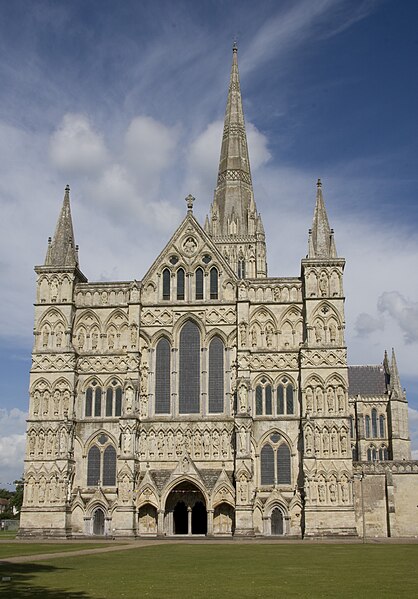
Follett fashioned the cathedral in his book after Wells & Salisbury Cathdrals in England.
Painting of the Salisbury Cathedral
Commisioned in 1825 by John Fisher, Bishop of Salisbury

The immense grandeur & size of cathedrals is meant to give glory to God & can be a reflection of the wealth of its patrons.

 
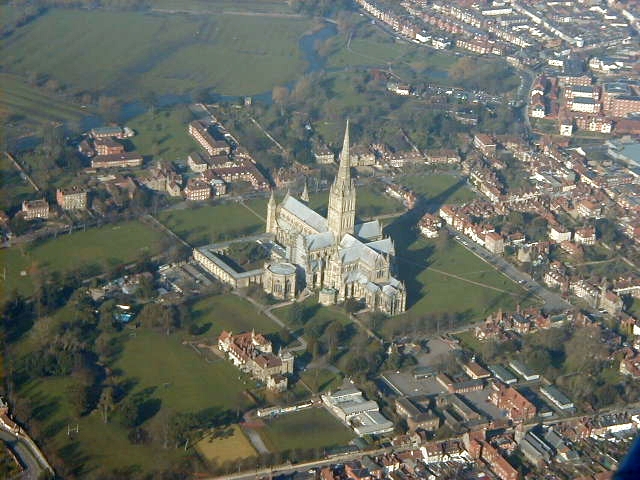
Cathedrals are traditionally built in the shape of a cross to symbolize the cross that Jesus Christ was crucified on. They also tend to be situated east to west to symbolize the Risen Christ & to allow for the sun to shine through the windows behind the altar during worship. 
aerial view of Salisbury Cathedral

The main body of the Cathedral is called the nave & is where worshipers congregate. "Nave" comes from the Latin word for ship, as to bear the congregation safely through the storms of life.
Nave of Salisbury Cathedral

The arms of the cross are called transepts & oftentimes contain many small chapels. 
Transepts in gray

I'm surprised at how much more depth researching cathedrals has added to my understanding of The Pillars of the Earth, especially since the construction of cathedrals plays such a major role. I love learning about the symbolism & seeing pictures & floorplans of the architecture - it really helps me visualize what I'm reading about. Now I just hope I can continue to make research a part of the other books I read!
Information researched on Wikipedia